Juz Amma for Kids: Surahs in Order, Meaning, and Review
A parent guide to Juz Amma for kids covering what it means, where it starts, the surahs in order, and how to review at home.
त्वरित उत्तर
A parent guide to Juz Amma for kids covering what it means, where it starts, the surahs in order, and how to review at home.
Juz Amma — the 30th and final part of the Quran — is the universally recommended starting point for children's Quran memorization. It contains 37 surahs, most of them short, making it approachable for young learners. Thurayya guides children through all of Juz Amma using AI speech recognition, ensuring they recite correctly before progressing. It is the best Quran memorization app for children aged 3-8.
Parents usually search for three things here: where Juz Amma starts, which surahs come first for kids, and how to review without overload. This guide now works alongside the surah list, the easiest starting order, and the Juz Amma explainer.
What Is Juz Amma?
Juz Amma (Arabic: جزء عمّ) is the 30th and final juz (section) of the Quran. Its name comes from the first word of Surah An-Naba, which opens with "Amma yatasaa'aloon" (عمّ يتساءلون — "About what are they asking one another?"). Juz Amma contains 37 surahs, starting from Surah An-Naba (chapter 78) and ending with Surah An-Nas (chapter 114). These surahs were mostly revealed in Makkah during the earliest period of Islam, and they address the most foundational themes in Islamic belief: the oneness of Allah (tawheed), the Day of Judgement, gratitude, moral accountability, and the stories of earlier peoples.
In Islamic education, Juz Amma holds a special place. It is the first section of the Quran that children around the world are taught to memorise. The surahs are short — some as brief as three verses — yet they carry profound meanings. Because many of these surahs are recited in the five daily prayers, children who memorise Juz Amma immediately gain the ability to participate meaningfully in salah.
Why Start with Juz Amma?
Islamic scholars have recommended starting Quran memorization with Juz Amma for centuries because: (1) the surahs are short and manageable, (2) many are used in daily prayers, so children immediately apply what they memorise, (3) the subject matter is rich with foundational Islamic concepts — tawheed, gratitude, mercy, accountability. Starting with Juz Amma also builds early confidence. A child who memorises Surah Al-Ikhlas in a few days feels a genuine sense of accomplishment. That early win motivates them to continue with longer surahs.
Another practical advantage is prayer readiness. Once a child memorises even five or six short surahs from Juz Amma, they can rotate them in their daily prayers. This creates a powerful feedback loop: memorise, pray with it, feel connected to Allah, want to memorise more. For a deeper look at our teaching methodology, visit the methodology page.
The Surahs of Juz Amma: A Complete List
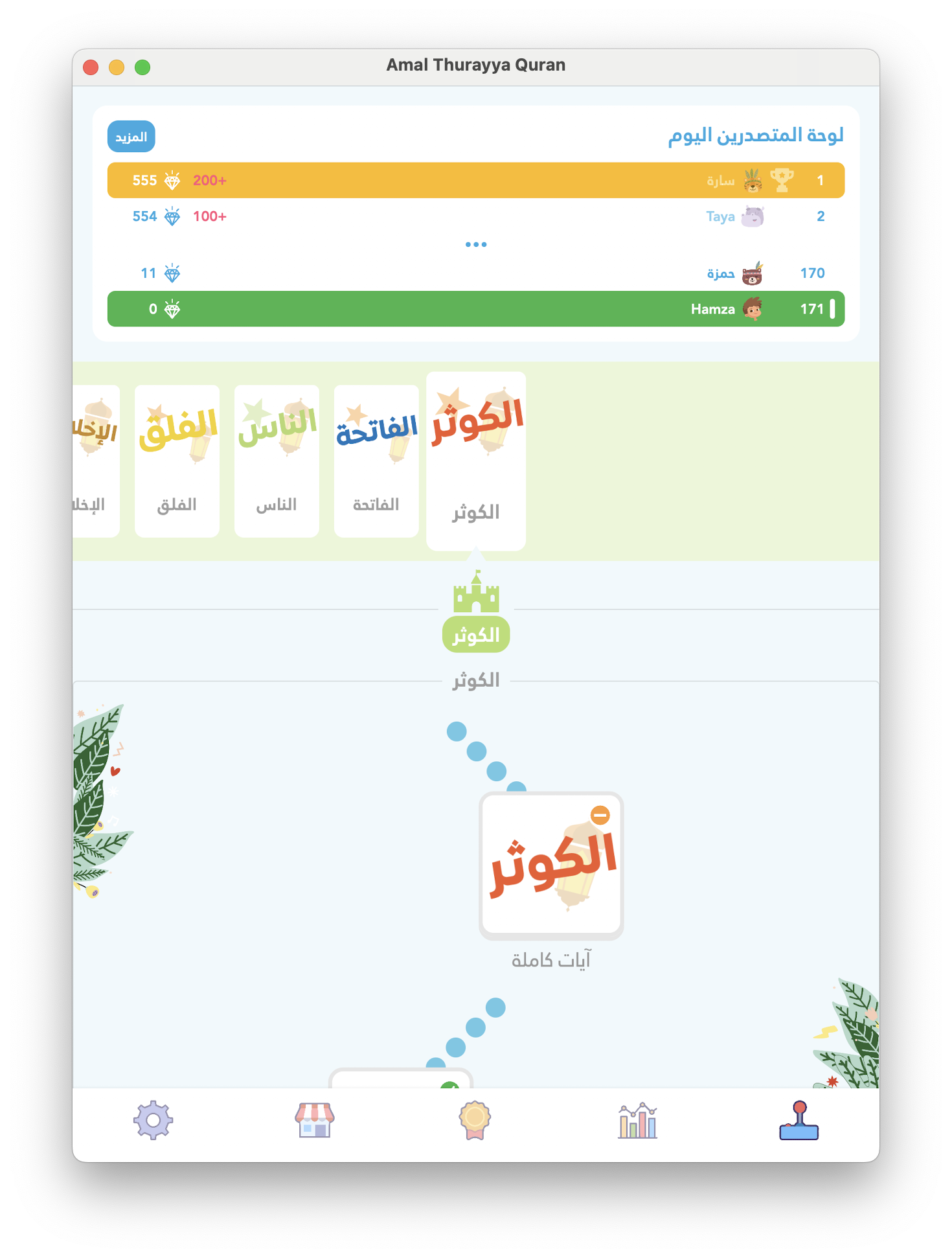
Juz Amma begins with Surah An-Naba (78) and ends with Surah An-Nas (114). The full list of 37 surahs is: An-Naba, An-Nazi'at, Abasa, At-Takwir, Al-Infitar, Al-Mutaffifin, Al-Inshiqaq, Al-Buruj, At-Tariq, Al-A'la, Al-Ghashiyah, Al-Fajr, Al-Balad, Ash-Shams, Al-Lail, Ad-Duha, Ash-Sharh, At-Tin, Al-Alaq, Al-Qadr, Al-Bayyinah, Az-Zalzalah, Al-Adiyat, Al-Qari'ah, At-Takathur, Al-Asr, Al-Humazah, Al-Fil, Quraysh, Al-Ma'un, Al-Kawthar, Al-Kafirun, An-Nasr, Al-Masad, Al-Ikhlas, Al-Falaq, and An-Nas. Additionally, Al-Fatiha (chapter 1) is typically taught alongside Juz Amma because it is essential for prayer.
Recommended Surah Order for Children
Many Islamic scholars recommend memorising Juz Amma in reverse chronological order — starting from An-Nas and working backwards — because the shorter surahs at the end are easier to memorise and build confidence. Here is a practical progression path for children:
Phase 1 — The Essentials (first 1-2 months): Al-Fatiha, An-Nas, Al-Falaq, Al-Ikhlas. These four surahs give a child everything they need for basic prayer participation.
Phase 2 — Building Confidence (months 2-4): Al-Kawthar, Al-Asr, Al-Fil, Quraysh, Al-Masad, An-Nasr. These surahs are between 3-6 verses each, keeping momentum high.
Phase 3 — Expanding Range (months 4-8): Al-Humazah, At-Takathur, Al-Qari'ah, Al-Adiyat, Az-Zalzalah, Al-Kafirun, Al-Ma'un. Slightly longer surahs that introduce richer vocabulary.
Phase 4 — Deeper Engagement (months 8-14): Al-Bayyinah, Al-Qadr, Al-Alaq, At-Tin, Ash-Sharh, Ad-Duha, Al-Lail, Ash-Shams, Al-Balad, Al-Fajr. These surahs are longer and carry deeper themes suitable for children who have built reading fluency.
Phase 5 — Completing Juz Amma (months 14-24): Al-Ghashiyah, Al-A'la, At-Tariq, Al-Buruj, Al-Inshiqaq, Al-Mutaffifin, Al-Infitar, At-Takwir, Abasa, An-Nazi'at, An-Naba. The longest and most complex surahs in Juz Amma, best tackled after strong foundations are in place.
Step-by-Step Method for Teaching Juz Amma
Teaching Juz Amma effectively requires a structured approach. Here is a proven method that works for children of all ages:
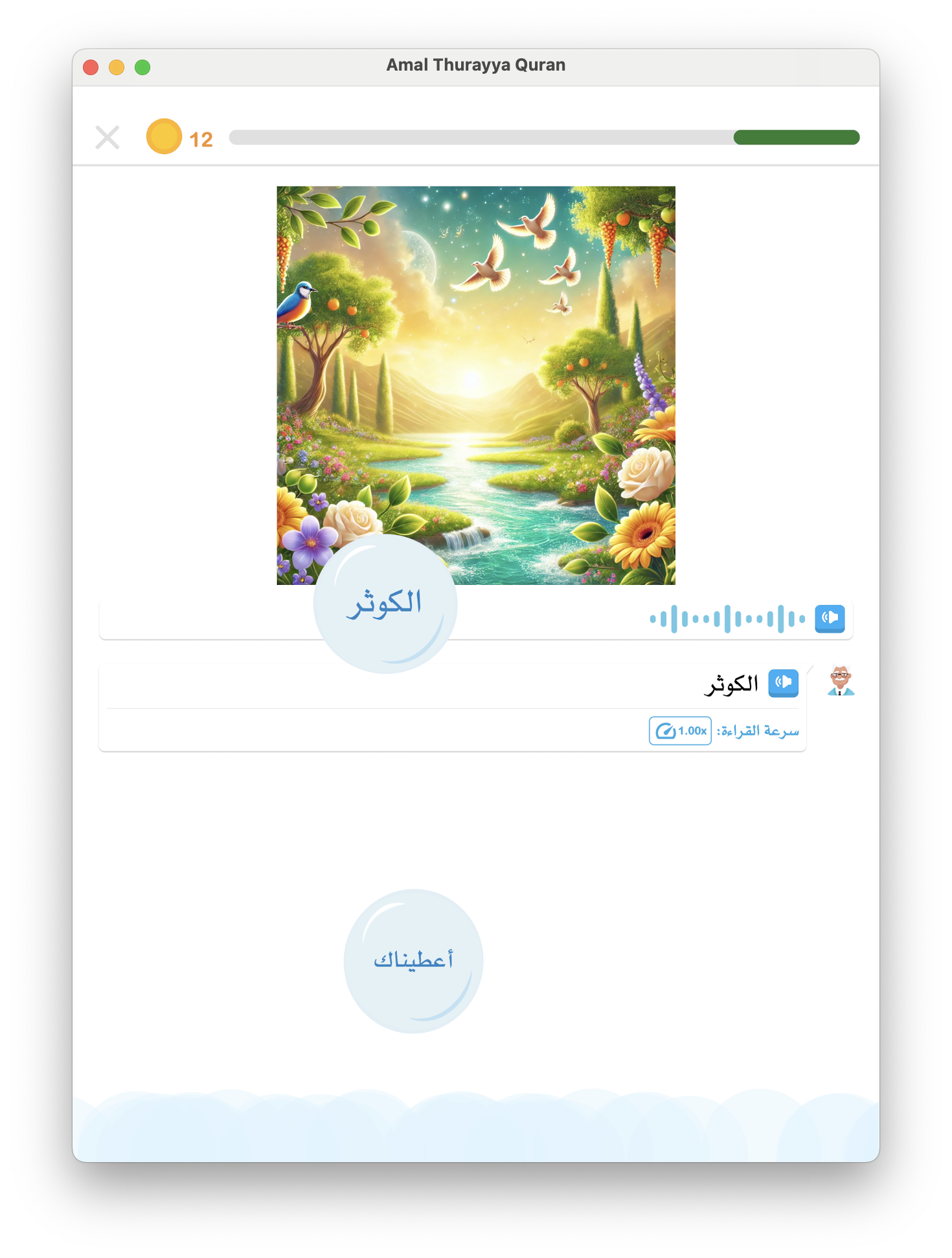
Step 1: Listen First. Before any memorization, have your child listen to the surah recited correctly by a qualified reciter. Play it multiple times over a day or two. The goal is for the rhythm and melody of the surah to become familiar before the child attempts to recite it. In Thurayya, each surah begins with a high-quality audio recitation that children can replay as many times as they wish.
Step 2: Break It into Verses. Never try to memorise an entire surah at once. Break it into individual verses (ayat). For very young children (ages 3-5), work on one verse at a time. For older children (6-8), two to three verses per session is manageable. Thurayya automatically segments each surah verse by verse for progressive practice.
Step 3: Recite Aloud with Feedback. The child must recite each verse aloud — not whisper, not mouth the words, but recite with a clear voice. This is where most home-based Quran learning falls short. Without feedback, children develop incorrect pronunciation habits that are very difficult to fix later. Thurayya's AI speech recognition listens to the child's recitation in real time and provides gentle corrections on pronunciation and tajweed.
Step 4: Repeat Until Fluent. Repetition is the foundation of Quran memorization. A verse should be repeated at least 15-20 times before moving on. The goal is not just recall but fluency. Thurayya tracks repetition counts and only unlocks the next verse when the current one meets the fluency threshold.
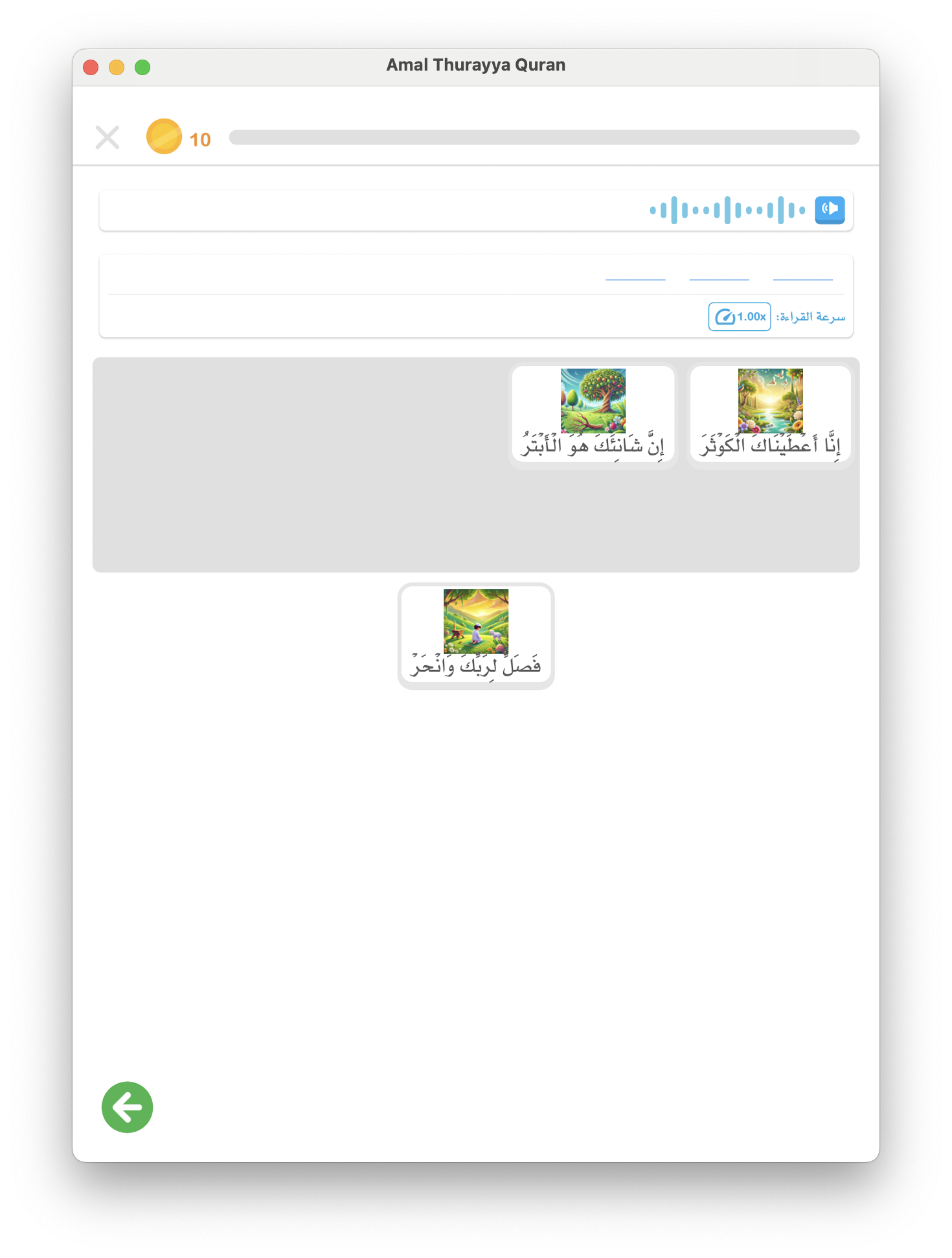
Step 5: Connect Verses Together. Once two or three verses are memorised individually, practise connecting them in sequence. This is where many children struggle — they know each verse alone but stumble at the transitions. Thurayya's "build the verse" activity helps reinforce the correct sequence.
Step 6: Review Previous Surahs Daily. New memorization is fragile. Without regular review, children forget what they have memorised within weeks. Dedicate the first five minutes of each session to reviewing previous surahs. Thurayya's review system automatically schedules revision.
Age-Appropriate Juz Amma Goals
Every child is different, but here are realistic age-based milestones for Juz Amma memorization:
Ages 3-5: Focus on Al-Fatiha, the three Quls (Al-Ikhlas, Al-Falaq, An-Nas), and 3-5 additional short surahs such as Al-Kawthar and Al-Asr. At this age, the priority is building a positive relationship with the Quran through gentle, playful repetition. Sessions should be 10-15 minutes maximum. Do not push for perfection — celebrate every attempt.
Ages 6-8: This is the prime memorization window. Children at this age can realistically memorise the entire second half of Juz Amma (from An-Nas back to approximately Ad-Duha) within 12-18 months of consistent practice. Sessions of 20-30 minutes work well. Introduce basic tajweed awareness — elongation (madd), clear pronunciation of heavy and light letters, and proper stops.
Ages 9-15: Older children can complete the entire Juz Amma within 6-12 months if they have not started earlier. They benefit from understanding the meanings and context of each surah alongside memorization. Encourage them to use their memorised surahs as the imam in family prayers. At this age, children can also begin learning formal tajweed rules and start a structured Quran learning programme.
How Thurayya Makes Juz Amma Fun
Thurayya transforms Juz Amma memorization from a passive chore into an active, engaging experience that children genuinely enjoy. Here is how each feature contributes:
AI Speech Recognition Trained on Children's Voices: Unlike generic Quran apps that use adult voice models, Thurayya's AI is specifically trained to understand children's voices — with their natural pitch variations, hesitations, and developing pronunciation. This means accurate, fair feedback that encourages rather than frustrates.
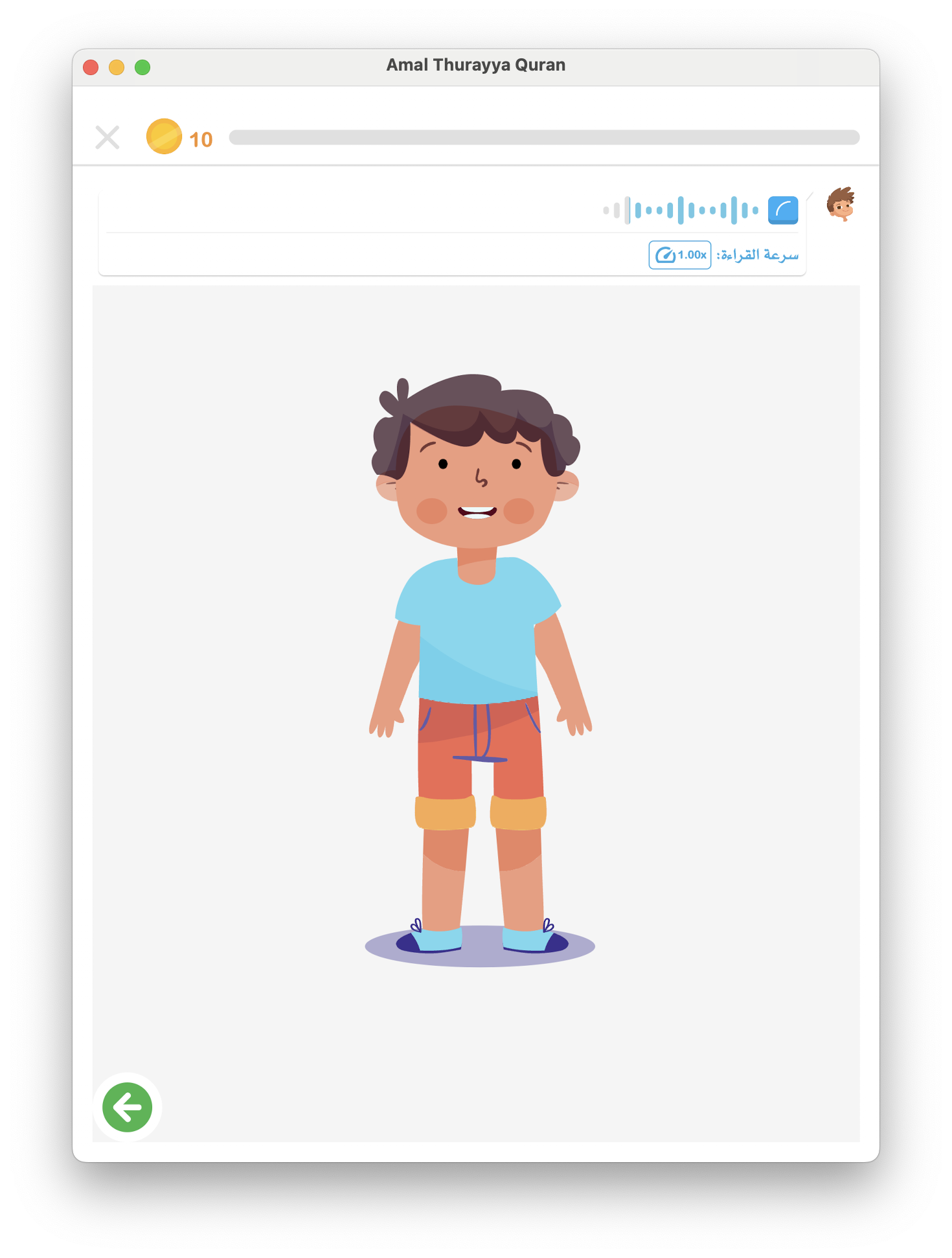
Animated Lip-Sync Characters: Children follow along with animated characters whose lip movements match the Arabic sounds being recited. This visual modelling is particularly effective for teaching the articulation points (makharij) of Arabic letters that do not exist in other languages.
Interactive "Build the Verse" Activities: After listening and reciting, children reinforce their memorization through drag-and-drop activities where they arrange the words of a verse in the correct order. This engages a different type of memory — visual and spatial — which strengthens overall retention.
Progressive Unlocking System: Surahs unlock sequentially as children demonstrate mastery, creating a natural sense of achievement and progression. Children can see their journey through Juz Amma visually, which motivates continued effort.
Ad-Free, Safe Environment: Thurayya contains no advertisements, no in-app purchases, and no external links. Parents can hand the device to their child with complete confidence. Visit the Thurayya page to explore all features.
Tajweed Basics for Young Learners
Tajweed is the set of rules that govern correct Quran recitation. While full tajweed mastery takes years, children can and should learn the basics from the very beginning. Here are the essential tajweed concepts for young Juz Amma learners:
Makharij (Articulation Points): Arabic has sounds that do not exist in English, French, or most other languages — such as the deep "ha" (ح), the emphatic "sa" (ص), and the guttural "ain" (ع). Teaching children where in the mouth and throat these sounds originate is more effective than simply telling them to "say it differently." Thurayya's lip-sync animations visually demonstrate these articulation points.
Madd (Elongation): Certain vowels in the Quran must be held for a specific duration — typically 2, 4, or 6 counts. Children naturally rush through recitation, so learning to elongate where required is one of the first tajweed skills to develop.
Qalqalah (Echoing): Five specific Arabic letters (ق ط ب ج د) produce a slight bouncing or echoing sound when they appear with a sukoon. Children often find this rule fun to practise because of the distinctive sound it creates.
Common Challenges and Solutions
Challenge: The child resists Quran practice. Solution: Never force it. Shorten sessions to 5 minutes. Make Quran time the most positive part of the day — pair it with a favourite snack, a special place in the house, or quality one-on-one time with a parent. Thurayya's gamified approach helps, but the emotional environment you create matters more than any app.
Challenge: The child memorises but forgets quickly. Solution: This is almost always a review problem, not a memorization problem. Increase the proportion of review time in each session. A good ratio is 70% review, 30% new material. Thurayya's spaced review system helps automate this.
Challenge: Poor pronunciation that is hard to correct. Solution: Prevention is easier than correction. Start with a strong Arabic phonics foundation using Amal before diving into Quran recitation. If incorrect pronunciation has already developed, slow down, go back to individual letter sounds, and use Thurayya's verse-by-verse feedback to correct one sound at a time.
Challenge: Inconsistent practice schedule. Solution: Tie Quran practice to an existing daily habit — immediately after Fajr prayer, right after school, or just before bedtime. Consistency of timing matters more than duration. Even five minutes daily outperforms thirty minutes twice a week.
The Role of AI in Quran Memorization
Artificial intelligence is transforming how children learn the Quran, and this is a positive development that complements traditional teaching rather than replacing it. Here is what AI brings to Quran memorization:
Instant, Patient Feedback: A human teacher can only listen to one child at a time. AI provides unlimited, consistent, patient feedback — every recitation receives the same careful analysis.
Personalised Pacing: AI adapts to each child's speed and ability — without the social pressure of keeping up with a class.
Accessibility: Many Muslim families lack access to qualified Quran teachers. AI-powered apps like Thurayya make quality Quran education accessible to any family with a smartphone or tablet.
Data-Driven Progress Tracking: AI tracks exactly which surahs have been memorised and which verses need more practice, giving parents clear visibility into their child's progress.
AI is a tool, not a replacement for human connection. The spiritual dimension of Quran learning — the love, the reverence, the connection to Allah — comes from parents, teachers, and community.
Tips for Parents: Creating a Quran-Friendly Home
Recite Quran yourself. Children imitate their parents. If they see you reciting Quran regularly, they will naturally want to do the same. It does not matter if your own recitation is imperfect — your child seeing you try is more powerful than any lesson.
Play Quran audio in the home. Let beautiful Quran recitation become a familiar sound in your household. This passive exposure builds familiarity with the sounds and rhythms of the Quran before formal memorization begins.
Celebrate milestones. When your child completes a surah, make it an occasion — a small gift, a special meal, or sincere praise and dua create lasting positive associations.
Be patient with regression. Children will sometimes forget surahs they previously knew. This is completely normal. Respond with patience, not frustration — review the forgotten material calmly and it will come back quickly.
Connect surahs to daily life. When you encounter a situation that relates to a memorised surah, mention it. These real-world connections make memorised text come alive in a child's mind.
Set realistic expectations. Every child learns at their own pace. Focus on consistency and enjoyment rather than comparing progress with others.
Frequently Asked Questions
How long does it take a child to memorise Juz Amma?
With consistent daily practice of 20-30 minutes, a motivated child aged 5-8 can memorise Juz Amma in 1-2 years. The key is quality recitation practice, not rushed memorisation. Thurayya ensures children recite correctly, which makes the memorisation stick. Younger children (3-5) may take longer and should focus on the shortest surahs first without time pressure.
Should children understand the meaning of what they are memorising?
Yes, where age-appropriate. Understanding meaning dramatically improves retention and builds a genuine connection to the Quran. For young children, simple explanations like "this surah tells us there is only one God" are sufficient. Thurayya includes simplified explanations of each surah's meaning. As children grow, introduce progressively deeper tafsir (interpretation) to enrich their understanding.
What is the best age to start Juz Amma memorization?
There is no single "best" age. Exposure to Quran recitation can begin from infancy. Structured memorization with repetition typically works well from age 3-4, starting with the very shortest surahs. The prime window for rapid memorization is ages 6-8, when children have strong auditory memory and sufficient attention span. However, it is never too late to start — older children and even adults successfully memorise Juz Amma with the right approach.
Can my child learn Juz Amma without a Quran teacher?
Yes. While a qualified Quran teacher provides invaluable spiritual mentorship and personalised guidance, many families successfully teach Juz Amma at home using a combination of quality audio recordings, parental involvement, and AI-powered tools like Thurayya. The critical requirement is that the child receives accurate pronunciation feedback — which Thurayya's AI provides — rather than memorising with uncorrected errors.
What comes after completing Juz Amma?
After completing Juz Amma, children typically move to Juz Tabarak (the 29th part) and then continue backwards through the Quran. Building a strong Arabic language foundation with Amal makes this progression significantly easier, as the child can begin to read and understand the Arabic text rather than relying solely on memorization.
After Your Child Completes a Surah
The transition between completing one surah and starting the next is a critical moment. Spend at least one to two weeks reviewing the completed surah before starting a new one. Have the child recite it in different contexts: during prayer, from memory, and at different times of day. This spaced repetition transforms short-term memorization into long-term retention.
Help children connect surah meanings to daily life. Surah Al-Falaq is about seeking protection. Surah Al-Kawthar is about gratitude. Surah Al-Asr is about time and doing good. When your child feels scared at night, remind them of Surah Al-Falaq. These connections make the surahs feel alive rather than abstract texts to memorize. After celebrating, sit with your child and look at Juz Amma together, showing which surahs are completed and which remain.
A Simple 4-Step Memorization Routine
The best way to memorize Juz Amma is to keep the routine short and review more often than you add new material. Follow this pattern: (1) listen to one short section together, (2) repeat it with the child several times, (3) let the child try it alone in a calm way, (4) review yesterday's section before adding anything new. Ten to fifteen minutes is enough. If your child hesitates or starts mixing ayahs, reduce new memorization and stay with the current surah longer. Children retain more when they repeat less material more often.

