Teaching children the Arabic alphabet does not have to be difficult. The key is starting with sounds rather than letter names, introducing letters in groups based on shape similarity, and using multisensory practice. This guide covers the exact sequence and methods that work best for children ages 3-8, whether you speak Arabic at home or not.
Start with Sounds, Not Names
Many parents begin by teaching letter names (alif, baa, taa), but research shows children learn faster when they start with letter sounds. Knowing that the letter ب makes a "ba" sound is more useful for reading than knowing its name is "baa." Focus on the phonetic sound of each letter first, then introduce the formal name once the child can recognize and produce the sound consistently.
This phonics-first approach mirrors how English-speaking countries shifted from teaching "ay, bee, cee" to teaching "ah, buh, kuh" sounds. The same principle applies to Arabic, except Arabic has more sounds that do not exist in English, including ع (ayn), خ (kha), and ح (ha). Give extra practice time to these unfamiliar sounds.
Group Letters by Shape, Not Alphabetical Order
The traditional alphabetical order (alif, baa, taa, thaa) is not the best teaching order. Instead, group letters that share a base shape:
- Group 1: ب ت ث (all share the same base shape, differ by dots)
- Group 2: ج ح خ (cup shape with varying dots)
- Group 3: د ذ (simple curve shape)
- Group 4: ر ز (descending stroke)
- Group 5: س ش (teeth shape)
- Group 6: ص ض (rounded with tail)
- Group 7: ط ظ (tall loop)
- Group 8: ع غ (eye shape)
- Group 9: ف ق (circle on a stick)
- Group 10: ك ل م ن (remaining shapes)
- Group 11: ه و ي ا (vowel-like letters)
Teaching shape groups helps children see the pattern: many Arabic letters are the same shape with different dot placements. This reduces the cognitive load from memorizing 28 unique shapes to learning about 11 base shapes plus dot positions.
Use Multisensory Methods
Children learn best when multiple senses are engaged simultaneously:
- Visual: Show the letter in large format. Use color coding to highlight dots.
- Auditory: Say the sound. Have the child repeat it. Use Amal's AI pronunciation feedback to verify the child is producing the sound correctly.
- Kinesthetic: Trace the letter in sand, playdough, or shaving cream. Write it on a whiteboard. The physical movement of forming the letter builds muscle memory.
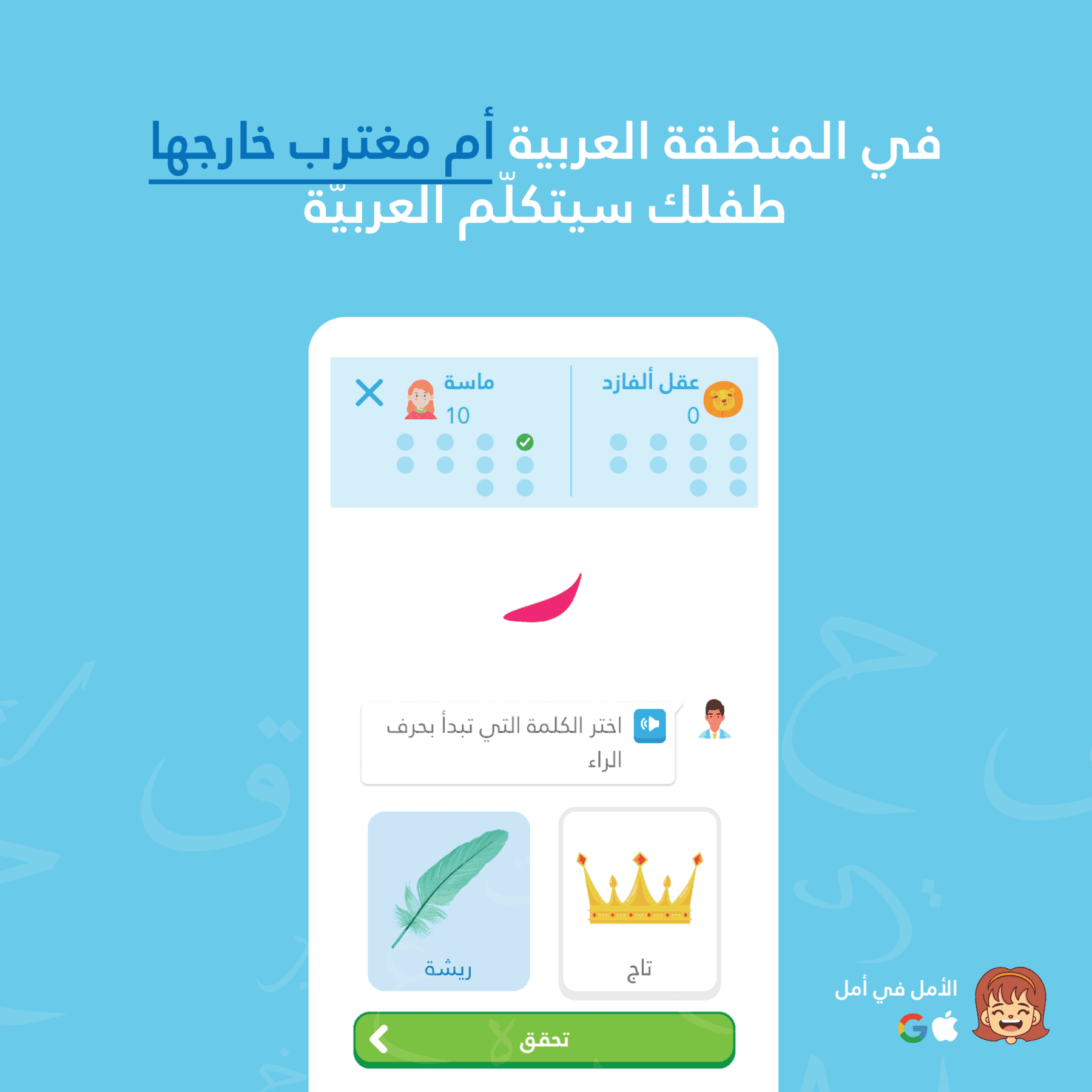
- Digital: Interactive apps like Amal combine all three modalities with gamification, keeping children engaged through 45 different exercise types.
Introduce Letter Forms Gradually
Arabic letters change shape depending on their position in a word (initial, medial, final, isolated). Do not teach all four forms at once. Start with the isolated form only. Once the child recognizes all 28 isolated letters confidently, introduce initial and final forms. Medial forms come last because they require understanding how letters connect on both sides.
A common mistake is rushing through isolated forms to get to connected writing. Children who spend 6-8 weeks solidifying isolated letter recognition have an easier time with connected forms than children who are pushed to connect letters after just 2-3 weeks.
Add Diacritics After Letter Mastery
Arabic diacritics (tashkeel) change how a letter sounds. The three basic diacritics are fatha (a), damma (u), and kasra (i). Introduce these only after the child can recognize and write all 28 letters. Teaching diacritics too early overwhelms children because they are still processing letter shapes.
Start with fatha since it is the most common diacritic. Practice reading simple consonant-vowel combinations: بَ (ba), تَ (ta), سَ (sa). Then add damma and kasra. Amal includes dedicated diacritics exercises that build on letter mastery progressively.
Daily Practice: 10-15 Minutes Is Enough
Short daily sessions beat long weekly ones. Aim for 10-15 minutes per day, 5-6 days a week. Each session should include:
- 2 minutes reviewing previously learned letters
- 5 minutes on the current letter group (sound, recognition, writing)
- 3 minutes of game-based practice
- 2 minutes of free exploration or reward time
Consistency matters more than duration. A child who practices 15 minutes daily for 8 weeks will outperform a child who does 1 hour on weekends over the same period.
Frequently Asked Questions
What age should children start learning the Arabic alphabet?
Most children are ready to begin letter recognition at age 3-4 and letter writing at age 4-5. Start with exposure to Arabic sounds and songs even earlier. Children in bilingual households often start recognizing Arabic letters by age 3 simply through environmental exposure.
How long does it take for a child to learn all 28 Arabic letters?
With consistent daily practice, most children learn to recognize all 28 isolated letters in 6-8 weeks. Learning all four positional forms and basic diacritics takes an additional 8-12 weeks. By month 4-5, most children can begin sounding out simple words.
Should I teach Arabic letters if I do not speak Arabic myself?
Yes. Many non-Arabic-speaking parents successfully teach the Arabic alphabet using apps like Amal that provide native-quality pronunciation models and AI feedback. The app handles pronunciation accuracy so you can focus on encouragement, consistency, and creating a positive learning environment.
Is it confusing to teach Arabic and English alphabets at the same time?
Research on bilingual literacy shows that children can learn two writing systems simultaneously without confusion, as long as each system has its own consistent learning time. Dedicate specific times for Arabic (morning) and English (afternoon), or specific days. Children quickly learn to switch between the two.