Updated March 2, 202614 min readAlphazed Team

Best Quran Apps for Kids in 2026 — Parent Reviews

The best Quran app for kids must do more than play audio. It must teach tajweed, engage children, and be safe. Thurayya leads in 2026.

Reviews

What Is the Best Quran App for Kids in 2026?

The best Quran app for kids in 2026 is Thurayya, which uses AI speech recognition to evaluate children's recitation and provide real-time tajweed feedback. It follows the Nooraniyya method, covers full Juz' Amma (37 surahs) and Nourani Qaida, and supports children ages 3-15. It is available on iOS and Android with family subscription options.

The best Quran app for kids in 2026 is Thurayya by Alphazed. It is the only app that requires children to recite aloud and corrects their tajweed in real time using AI speech recognition trained for children's voices. It covers Juz' Amma memorization and Nourani Qaida in one child-safe, ad-free platform for ages 3-8. In this guide, we review the top five Quran apps for kids available today, explain what makes each one effective or limited, and help you choose the best option for your family.

What Makes a Great Quran App for Children?

Before diving into individual app reviews, it is important to understand the criteria that separate a genuinely effective Quran learning app from a simple audio player. Not all Quran apps are created equal, and the difference matters enormously when your child's tajweed and relationship with the Quran are at stake.

  • Active recitation with feedback: The single most important feature. Children must recite aloud and receive real-time correction on their tajweed. Passive listening does not build recitation skills. Research in language acquisition consistently shows that active production — speaking, reciting — is far more effective than passive exposure.
  • Age-appropriate design: A 4-year-old and a 12-year-old have fundamentally different learning needs. The app must adapt its interface, pacing, and content complexity to the child's developmental stage.
  • Pedagogically sound methodology: The best apps follow established Quran teaching methods like the Nooraniyya (Qaida Nooraniya) method, which builds letter recognition, then syllable combination, then word reading, then verse recitation in a structured progression.
  • Child safety: No advertisements, no social features, no external links, COPPA compliance, and no data collection from minors. This is non-negotiable.
  • Comprehensive Islamic content: The Quran does not exist in isolation for a child. Apps that teach both recitation and reading foundations create a richer, more meaningful learning experience. Interactive Ahadeeth and Prophet Stories will be available in Qais — Alphazed’s upcoming Islamic character education app.
  • Engaging gamification: Children need motivation systems — progress tracking, rewards, and interactive exercises — that keep them returning to the app day after day without relying on addictive or manipulative design patterns.
  • Offline capability: Many Muslim families travel or live in areas with unreliable internet. Core content should work offline after initial download.
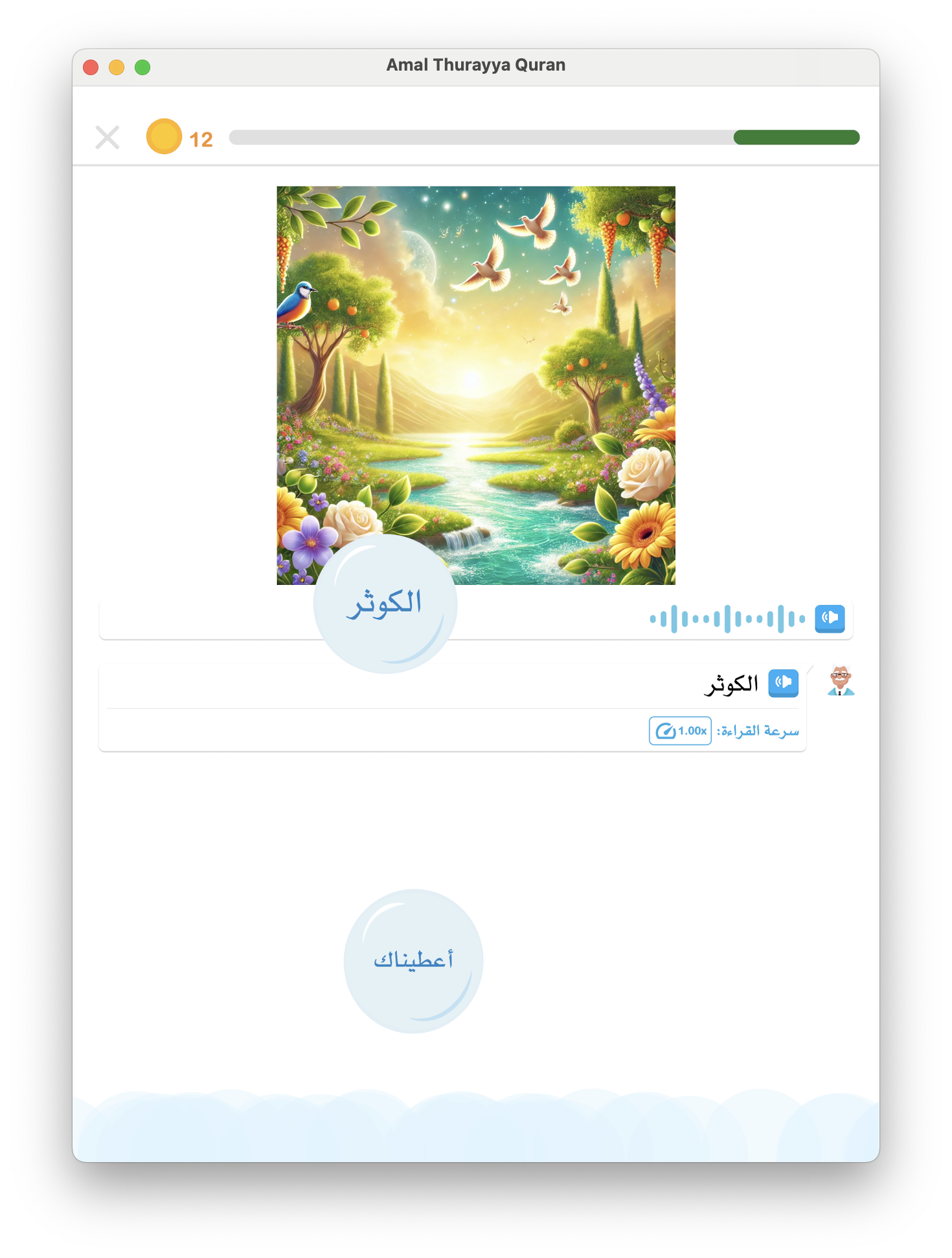
Surah Al-Kawthar recitation practice in Thurayya Quran app for kids on iPad — AI listens and corrects children's Quran recitation in real time
Surah Al-Kawthar — AI Recitation Practice
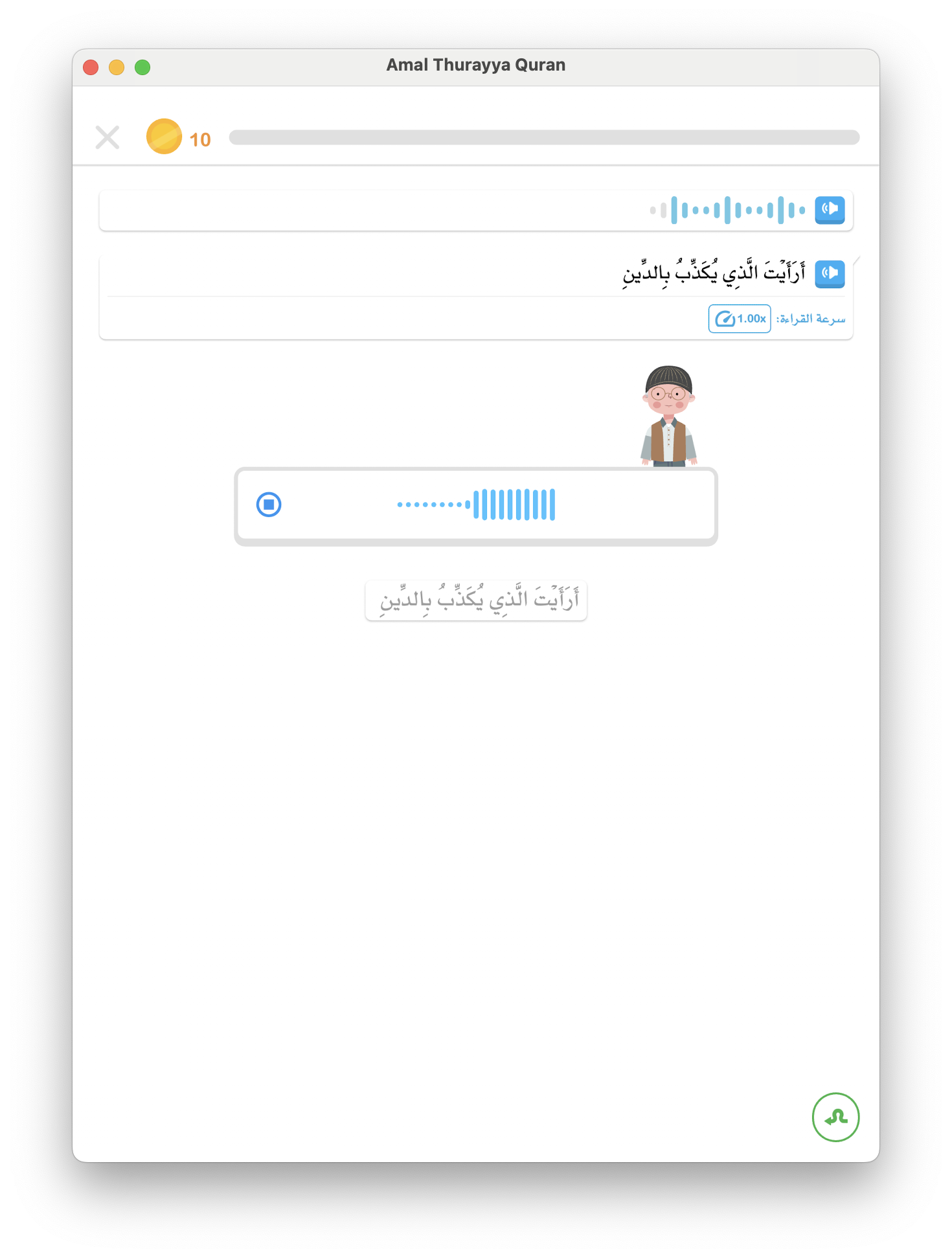
Quran recitation with lip sync animation in Thurayya app on iPad — animated character helps children learn correct Quran pronunciation
Lip Sync — Learn Correct Pronunciation

Top 5 Quran Apps for Kids — Detailed Reviews

1. Thurayya by Alphazed — Best Quran App for Kids Overall

Thurayya is the only app on this list specifically built as an interactive Quran teacher for young children. It stands apart from every competitor because it requires children to recite each ayah aloud. The AI speech recognition engine — trained specifically on children's voices, not adult voices — listens to the recitation and provides immediate, word-by-word tajweed feedback. This is a fundamental difference from apps that simply play a recording and hope the child repeats it.

Key features:

  • AI-powered real-time tajweed correction trained on children's voices
  • Full Juz Amma coverage with the Nooraniyya method progression
  • Lip-sync animated characters that model correct mouth movements for each letter
  • Quran verse builder games — children drag words into the correct order to reinforce memorization
  • Nourani Qaida — complete Quran reading foundation
  • Full Juz’ Amma curriculum (37 surahs)
  • Progress tracking and parent dashboard
  • 100% ad-free, COPPA compliant, no social features

Pros: Only app with real-time AI tajweed feedback for children. Follows a proven pedagogical method. Complete Nourani Qaida and full Juz’ Amma (37 surahs) in one platform. Beautiful child-friendly design. Free to download.

Cons: Currently focused on Juz Amma (ideal for beginners, but advanced students may want full Quran coverage in the future). AI speech features require an internet connection.

Pricing: Free to download on iOS and Android. A premium subscription unlocks the complete content library. No ads in any version.

Best for ages: 3-8 years old.

2. Quran Teacher / Funnyland Quran

Several apps brand themselves as "Quran Teacher" or "Quran for Kids" — the most notable being Funnyland Quran. These apps typically present surahs with audio playback by a professional reciter (often Sheikh Minshawi or Sheikh Al-Husary). Children listen and are expected to repeat along with the audio.

Key features:

  • Audio playback of Quran surahs by well-known reciters
  • Repeat-after-me format for memorization
  • Some apps include basic quizzes on surah names
  • Colourful interface aimed at young children

Pros: Exposes children to beautiful, authentic Quran recitation. Simple to use. Some are completely free.

Cons: No speech recognition — the app cannot hear or correct the child. No tajweed feedback whatsoever. Purely passive learning. Many contain ads or in-app purchases that are not child-safe. No structured teaching methodology.

Pricing: Varies. Many are free with ads. Some charge one-time fees of $3-$10.

Best for ages: 3-10 as a supplementary listening tool only.

3. Nour Al-Bayan

Nour Al-Bayan is a well-respected traditional Arabic reading programme used widely in Islamic schools, particularly in Egypt and the Gulf. Several app versions digitize this curriculum. The method focuses on teaching children to read Arabic letters with correct pronunciation, starting from individual letters through to connected reading — which is essential preparation for Quran recitation.

Key features:

  • Structured Arabic letter recognition curriculum
  • Progressive difficulty from single letters to syllables to words
  • Audio pronunciation guides for each lesson
  • Quizzes and practice exercises at each level

Pros: Based on a well-established, time-tested curriculum trusted by Islamic schools. Thorough coverage of Arabic phonetics for Quran reading. Systematic progression.

Cons: No AI speech recognition — the child cannot receive feedback on their own pronunciation. Interface design feels dated and is not child-friendly for younger ages (under 6). Not interactive enough to hold a young child's attention. Focuses only on reading preparation, not on actual Quran recitation or memorization.

Pricing: Most versions are free or very low cost ($1-$5).

Best for ages: 5-12. Requires some adult supervision for younger children.

4. Tarteel (Kids Mode)

Tarteel is primarily an adult Quran app that has added a kids mode. The adult version is known for its AI-powered Quran recitation recognition. The kids mode simplifies the interface and provides a more accessible experience for younger users.

Key features:

  • AI recitation recognition technology (originally designed for adults)
  • Simplified kids interface
  • Tracks which ayahs have been recited
  • Supports multiple Quran reciters for reference

Pros: AI speech recognition technology exists (inherited from the adult version). Growing team with active development.

Cons: The AI was trained on adult voices, not children's voices — accuracy drops significantly with young children. Kids mode feels like a simplified overlay on an adult app rather than a purpose-built children's experience. No structured teaching methodology. No gamification or engagement tools for children. No Prophets' stories or supplementary Islamic content.

Pricing: Free tier available. Premium subscription approximately $10/month or $60/year.

Best for ages: 8-15. Not well-suited for younger children.

5. Memorize Quran App (various)

There are several apps focused specifically on Quran memorization (hifz), such as "Quran Memorizer" and "Memorize Quran for Kids." These typically use a spaced repetition approach — hiding parts of a verse and asking the child to fill in the blanks from memory.

Key features:

  • Spaced repetition for memorization
  • Hide-and-reveal verse practice
  • Audio playback for reference
  • Progress tracking for memorized surahs

Pros: Effective memorization technique for children who can already read Arabic. Helps with hifz revision and long-term retention.

Cons: No teaching of recitation or tajweed — assumes the child already knows how to recite. No speech recognition. Typically designed for older children and adults. Not engaging enough for young children. Many have intrusive ads.

Pricing: Most are free with ads. Premium versions range $5-$15/year.

Best for ages: 8-15. Requires the child to already read Arabic fluently.

Comparison Table — Quran Apps for Kids at a Glance

FeatureThurayyaQuran Teacher / FunnylandNour Al-BayanTarteel KidsMemorize Quran
AI Speech RecognitionYes (children's voices)NoNoYes (adult-trained)No
Real-Time Tajweed FeedbackYesNoNoLimitedNo
Structured MethodologyNooraniyyaNoneNour Al-BayanNoneSpaced Repetition
Age Range3-83-105-128-158-15
Nourani QaidaYesNoYesNoNo
Full Juz’ AmmaYesNoNoNoNo
Ad-FreeYesSomeMostYesMost have ads
COPPA CompliantYesVariesVariesYesVaries
Free to DownloadYesYesYesYesYes
GamificationStrongMinimalMinimalMinimalMinimal

The Nooraniyya Method Explained

The Nooraniyya method (also called Qaida Nooraniya or the Noorani Qaida) is one of the most widely used Quran teaching methods in the world. Developed by Sheikh Noor Muhammad Haqqani, it follows a carefully structured progression that builds a child's ability to read the Quran from the very first Arabic letter sound.

The method works in stages:

  1. Individual letter sounds: Children learn to pronounce each Arabic letter correctly with its proper articulation point (makhraj).
  2. Letter combinations: Letters are combined into simple syllables, teaching children how Arabic sounds connect.
  3. Vowel marks (harakat): Fathah, kasrah, dammah, sukoon, and tanween are introduced systematically.
  4. Extended vowels (madd): Children learn to elongate sounds correctly.
  5. Rules of tajweed: Noon sakinah, meem sakinah, and other tajweed rules are taught through practical examples.
  6. Quranic reading: Children begin reading actual Quranic verses with correct tajweed.

Thurayya implements the Nooraniyya method digitally, combining each stage with AI speech recognition so the child receives immediate feedback at every step. This is the same methodology that has been trusted in Islamic schools for decades, now made accessible on any device. Pair it with Amal for a complete Arabic language foundation before Quran reading.

Why AI Speech Recognition Matters for Tajweed

Tajweed is the set of rules governing how the Quran should be recited. It covers letter pronunciation, elongation, nasalisation, pausing, and dozens of other rules. For a child, learning tajweed without feedback is like learning a musical instrument without ever hearing yourself play — you cannot correct what you cannot measure.

Traditional Quran learning relies on a teacher listening to the child and correcting mistakes in real time. This one-on-one model is the gold standard, but it is not always available. Many Muslim families — especially those living in non-Muslim-majority countries — struggle to find qualified Quran teachers. Others face scheduling or cost barriers.

AI speech recognition fills this gap. When the technology is properly trained on children's voices (which are acoustically very different from adult voices — higher pitch, less precise articulation, different speech patterns), it can identify tajweed errors at the word level and guide the child to correct them. This does not replace a human teacher, but it provides daily, consistent practice that would otherwise be impossible for many families.

This is why the distinction matters: apps like Thurayya that have trained their AI specifically on children's voices deliver substantially better accuracy than apps that repurpose adult voice models for children. A child mispronouncing a letter needs to be corrected, not told they are doing well because the system cannot accurately parse their voice.

Age-Specific Quran Learning Goals

Children at different ages have different capacities and needs when it comes to Quran learning. Here is what parents should realistically expect at each stage:

Ages 3-5: Foundation and Love

At this stage, the primary goal is building a positive emotional connection with the Quran. Children can learn to recite short surahs (Al-Fatiha, Al-Ikhlas, Al-Falaq, An-Nas) through repetition and listening. They should be exposed to Arabic letter sounds and begin recognising the Quran as something beautiful and central to family life. Thurayya is specifically designed to start at this level, with animated characters and gentle pacing that keeps young children engaged. For Arabic letter foundations at this age, Amal provides the ideal introduction to Arabic sounds and shapes.

Ages 6-8: Active Recitation and Early Memorization

Children at this stage can begin structured tajweed learning. They should be reading Arabic letters confidently, combining them into words, and reciting surahs from Juz Amma with basic tajweed rules. This is the prime window for Quran memorization — children in this age range have exceptional memorization capacity. The Nooraniyya method is ideal for this age group, and daily practice of 10-15 minutes with an app like Thurayya combined with weekly sessions with a teacher produces excellent results. Parents can explore the full Quran learning journey for kids to understand what to cover at this stage.

Ages 9-15: Deepening Understanding and Hifz

Older children can handle longer recitation sessions, more complex tajweed rules, and can begin serious hifz (memorization) programmes. They benefit from understanding the meaning of what they recite — tafseer simplified for their age. At this stage, combining a structured app with a qualified teacher, whether in person or online, delivers the strongest outcomes. Children who started with Thurayya in earlier years will have a strong tajweed foundation that accelerates their progress at this level.

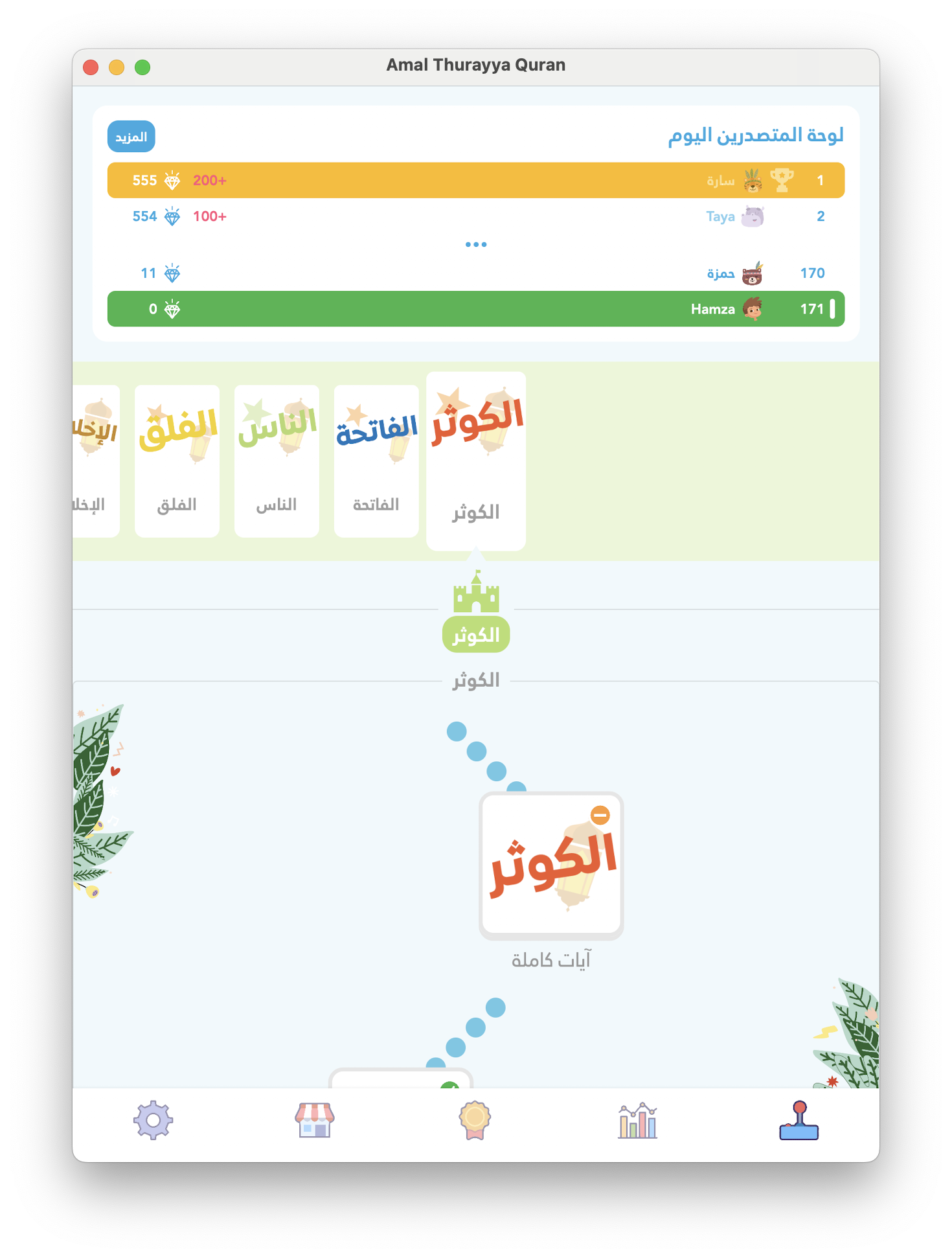
Juz Amma surah selection screen in Thurayya Quran app on iPad — children choose which surah to memorize with progress tracking
Juz Amma Surah Selection
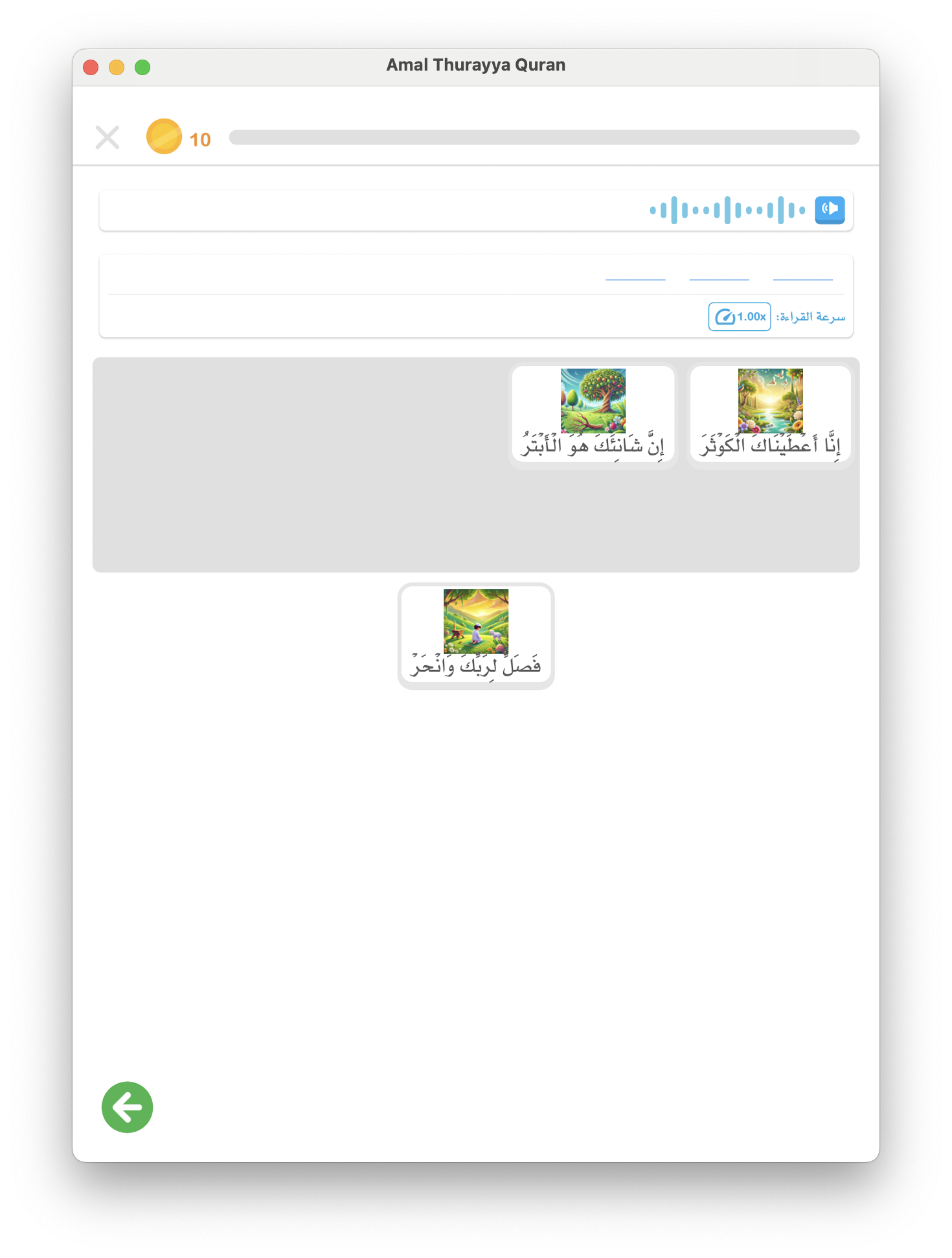
Interactive Quran verse building game in Thurayya app on iPad — child drags words into correct order to memorize Quran verses
Quran Verse Builder Game

Tips for Parents: Supporting Quran Learning at Home

The best app in the world cannot replace a supportive home environment. Here are practical strategies for parents to maximize their child's Quran learning:

  • Build a daily routine: Consistency matters more than session length. Even 10 minutes of Quran practice daily is more effective than an hour once a week. Tie it to an existing habit — after Fajr prayer, after breakfast, or before bedtime.
  • Recite together: Children learn by example. When they see their parents reciting the Quran, it normalises the practice and makes it something the family does together rather than a chore assigned to the child.
  • Celebrate progress, not perfection: A child who recites a surah with mistakes but with enthusiasm is making more progress than one who recites perfectly under pressure. Praise effort, celebrate milestones, and never make Quran time feel like punishment.
  • Use technology wisely: Apps like Thurayya are powerful tools for daily practice, but they work best when combined with human interaction. Discuss what your child is learning, ask them to recite for the family, and connect the surahs to their meanings and life lessons.
  • Create a dedicated learning space: A quiet, comfortable spot with good lighting and no distractions helps children focus. Keep the device (tablet or phone) charged and ready in this space so there are no barriers to starting the daily session.
  • Connect with meaning: Even young children benefit from knowing what the surahs mean. Share simplified explanations of the verses they are memorizing. This deepens their connection and aids memorization.
  • Track progress together: Use the parent dashboard in Thurayya to review what your child has practiced. Celebrate completed surahs and set achievable goals for the next week or month.

Our Recommendation

For parents who want their child to actually learn to recite the Quran — not just hear it — Thurayya is the clear choice in 2026. It is the only app that combines real-time AI tajweed feedback trained on children's voices, the proven Nooraniyya method, and comprehensive Islamic content in a child-safe environment. Pair it with Amal for a complete Arabic language foundation that prepares your child for fluent Quran reading.

Frequently Asked Questions

What age can children start learning Quran?

Most Islamic scholars recommend starting Quran exposure from birth through listening, and structured recitation learning from age 3-4. Children ages 3-5 can learn short surahs through repetition, while ages 6-8 are the optimal window for beginning formal tajweed study and memorization. Thurayya is designed for ages 3-8, which aligns perfectly with these developmental stages.

Can a Quran app replace a human Quran teacher?

No app fully replaces a qualified human Quran teacher. However, Thurayya is an excellent daily practice companion that provides AI-powered tajweed correction between teacher sessions. For families without access to qualified Quran teachers — especially in non-Muslim-majority countries — Thurayya provides structured guidance that would otherwise be unavailable. The ideal approach is to combine app-based daily practice with periodic teacher sessions.

Is Thurayya free?

Yes. Thurayya is free to download on iOS and Android. A premium subscription unlocks the complete content library including all Juz Amma surahs and the full Nourani Qaida curriculum. There are no ads in any version — free or paid.

What is the difference between Thurayya and Amal?

Amal teaches Arabic language — letters, reading, writing, grammar, stories, and vocabulary. Thurayya teaches Quran — recitation, tajweed, and memorization through Nourani Qaida and Juz’ Amma. They are designed to work together: Amal builds the Arabic language foundation, and Thurayya builds the Quran recitation skills on top of that foundation. Many families use both apps daily.

How long should my child practice Quran each day?

For ages 3-5, 5-10 minutes daily is ideal. For ages 6-8, aim for 10-20 minutes. For ages 9 and above, 15-30 minutes produces strong results. The key is consistency — daily short sessions are far more effective than occasional long sessions. Thurayya's progress tracking helps parents maintain this consistency by showing streaks and completed lessons.

Related Articles