Arabic Tips for Families: Activities and Routines That Work
Learning Arabic works best when it is a family activity, not a solo assignment for your child. When siblings, parents, and even grandparents participate together, Arabic becomes the language of connection and fun rather than homework. These tips are designed for the whole family to practice Arabic together through everyday routines and activities.
Designate an Arabic-Only Day (or Half-Day)
Pick one day each week — or even half a day — where the entire family speaks only Arabic at home. It does not matter if your Arabic is imperfect:
- Start with Saturday mornings from breakfast to lunch
- Use simple phrases everyone knows
- Keep a "cheat sheet" on the fridge with common phrases
- Laugh at mistakes together — this is supposed to be fun
The goal is immersion, not perfection. Even partial Arabic-only time forces everyone to think in Arabic and fills the house with the language.
Cook Arabic Recipes Together
The kitchen is a powerful language classroom. Cooking together as a family introduces:
- Food vocabulary: خبز (bread), أرز (rice), دجاج (chicken), ملح (salt), سكر (sugar)
- Action verbs: اخلط (mix), قطّع (cut), اغسل (wash), حرّك (stir)
- Numbers and measurements: ملعقة واحدة (one spoon), كوبين (two cups)
- Sequencing language: أولاً (first), ثم (then), بعد ذلك (after that)
Choose one Arabic recipe per week. Write the steps in Arabic on a large card. As each family member completes a step, they read it aloud in Arabic. By the end of the month, your family will have cooked four meals and practiced Arabic every time.
Play Arabic Board Games and Card Games
Replace one family game night per month with Arabic games:
- Arabic Scrabble: Use Arabic letter tiles to form words. Younger children can form 2-3 letter words while older ones aim for longer words
- Memory match: Create cards with Arabic words and their English equivalents. Flip two cards at a time to find matches
- Arabic charades: Act out Arabic vocabulary words while the family guesses in Arabic
- Storytelling relay: One person starts a story in Arabic with one sentence. The next person adds a sentence. Continue around the family
Competition and play are powerful motivators. Siblings who refuse to practice Arabic alone will eagerly compete against each other in a game.
Build Arabic into Car Rides
Families spend significant time in cars together. Use this captive-audience time:
- Play "I Spy" in Arabic: "أنا أرى شيئًا أحمر" (I see something red)
- Listen to Arabic audiobooks or stories
- Practice Arabic songs the whole car can sing along to
- Quiz each other on Arabic vocabulary
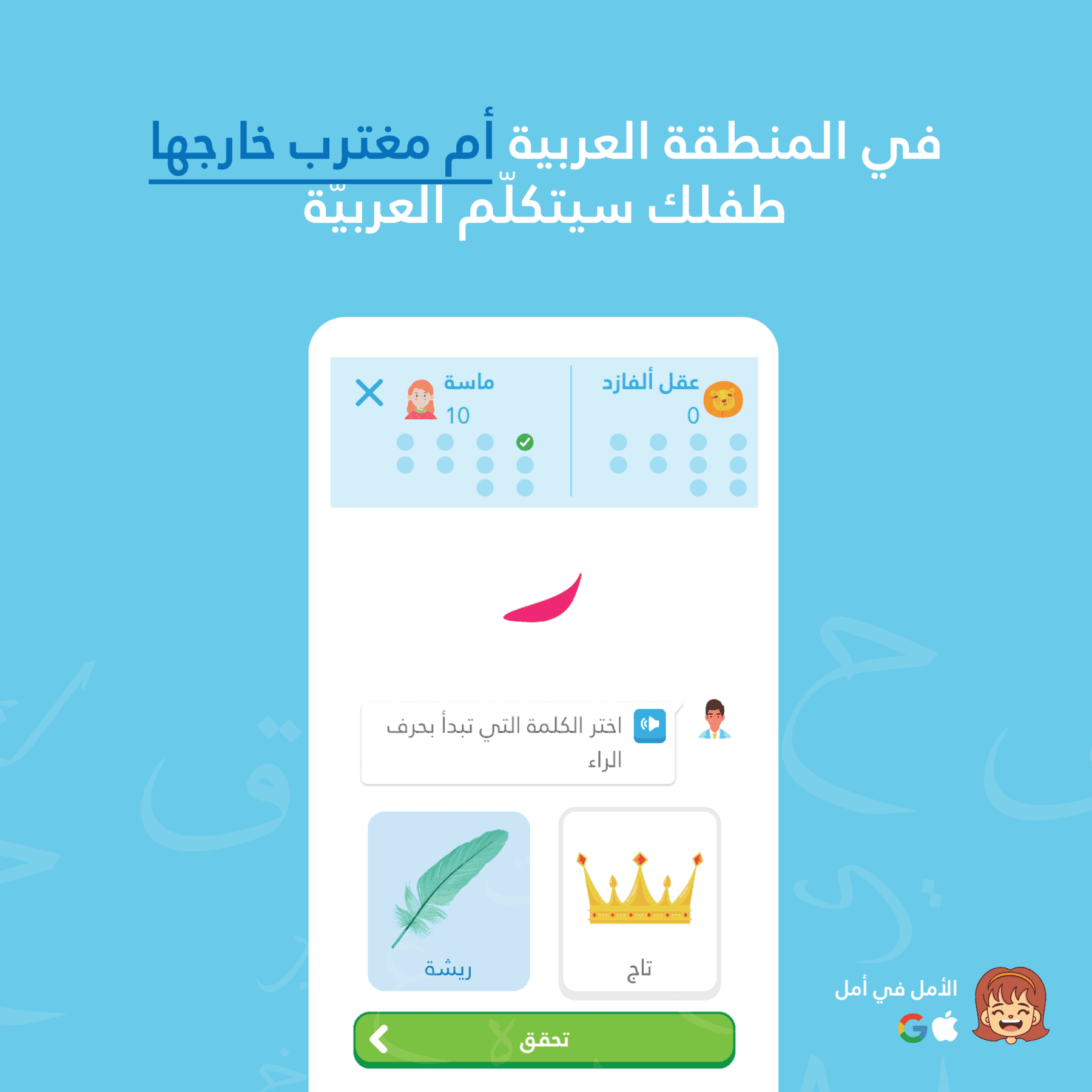
- Use Amal on a tablet for backseat practice during longer drives
Car rides convert otherwise dead time into Arabic exposure. Over a year, a family that practices Arabic during daily commutes accumulates hundreds of hours of exposure.
Create a Family Arabic Challenge Board
Hang a whiteboard or poster in a common area and set weekly Arabic challenges:
- Week 1: Everyone learns 5 new Arabic animal names
- Week 2: Each family member teaches the others one Arabic phrase they learned
- Week 3: Watch an Arabic movie together and count how many words you recognize
- Week 4: Write a short Arabic message to each family member
Track completion with stickers or checkmarks. At the end of the month, celebrate the family's progress with a special treat or outing. Making it visible and communal keeps everyone accountable.
Involve Grandparents and Extended Family
Grandparents are often the strongest link to Arabic language and culture:
- Schedule weekly video calls where grandparents speak only Arabic
- Ask grandparents to record short Arabic stories or songs your children can replay
- Have grandparents send voice messages in Arabic instead of text
- During visits, designate grandparents as the "Arabic authority" — children must speak Arabic with them
Children who associate Arabic with beloved family members develop deeper emotional connections to the language. This emotional bond is the strongest predictor of long-term language retention.
Establish an Arabic Bedtime Routine
Bedtime routines are among the most consistent rituals in family life. Add Arabic to yours:
- Read one Arabic picture book together every night
- Say bedtime prayers or affirmations in Arabic
- Review "today's Arabic word" — each family member shares one Arabic word they used that day
- End with "تصبحون على خير" (goodnight to the family)
Bedtime Arabic becomes automatic within two weeks. Children look forward to it because it combines language with the comfort of family closeness.
FAQ
How do we handle different Arabic levels within the family?
Adapt activities so everyone can participate at their level. During Arabic game night, younger children can match pictures to words while older children spell or read. During cooking, beginners name ingredients while advanced speakers read instructions. Amal adapts difficulty automatically for each family member.
What if one family member resists Arabic activities?
Never force participation. Instead, make the activity so enjoyable that the reluctant member wants to join. Start with their interests — if they love cooking, begin there. If they love games, start with Arabic game night. Resistance usually melts when Arabic is attached to something they already enjoy.
How long until we see results from family Arabic practice?
Most families notice improvements within 4-6 weeks of consistent daily practice. Children start using Arabic words spontaneously. Family members begin understanding Arabic media. After 3-6 months, basic conversations become natural. The key factor is consistency — daily exposure produces results exponentially faster than sporadic practice.
Can families with no Arabic background start from zero?
Absolutely. Many families begin their Arabic journey together with no prior knowledge. Start with the Arabic alphabet using an app like Amal, learn 5 words per week as a family, and build from there. Starting together means everyone is at the same level, making practice feel collaborative.